
Pain does not have to be a life sentence
Clinical hypnotherapy for chronic pain, back and neck pain, migraine, fibromyalgia and injury recovery — with a Washington State Registered Hypnotherapist. Sessions are online, personalised, and you leave with a recording made for your body.
 Eugene Berezin, MA
Registered Hypnotherapist · WA #HYPN.HP.70073119
Eugene Berezin, MA
Registered Hypnotherapist · WA #HYPN.HP.70073119
- MA in Psychology
- 10+ years in mental health
- LGBTQ+ affirming
- Private pay · HSA/FSA accepted
You have probably already tried a lot
Imaging that came back unremarkable. Physical therapy that helped a bit. Medication that takes the edge off and costs you something else. A specialist who said the words "you may have to learn to live with it."
That sentence is where most of my clients start. Not because they are out of options, but because the options they were given all pointed at tissue — and their pain stopped being mainly about tissue a long time ago.
Persistent pain is produced by a nervous system that has become very good at making it. That is not the same as saying it is imaginary. It is real, it hurts, and it is also learned — which is precisely why it can be worked with.

Hypnotherapy for pain, by condition
Different pain problems need different work. Start with whichever is closest to yours.

Chronic pain
Pain that has outlived its usefulness — months or years of it. Hypnosis works on how your nervous system keeps producing the signal.
Read more
Back and neck pain
Lower back, upper back, shoulders and neck — including the guarding and bracing that keep the muscles switched on.
Read more
Migraines and headaches
Migraine, tension headache and the stress cycle that triggers them. Hypnosis is one of the better-evidenced non-drug options here.
Read more
Injury and surgery recovery
Post-injury and post-surgical pain, where the evidence for hypnosis is strongest — plus the fear of re-injury that slows people down.
Read more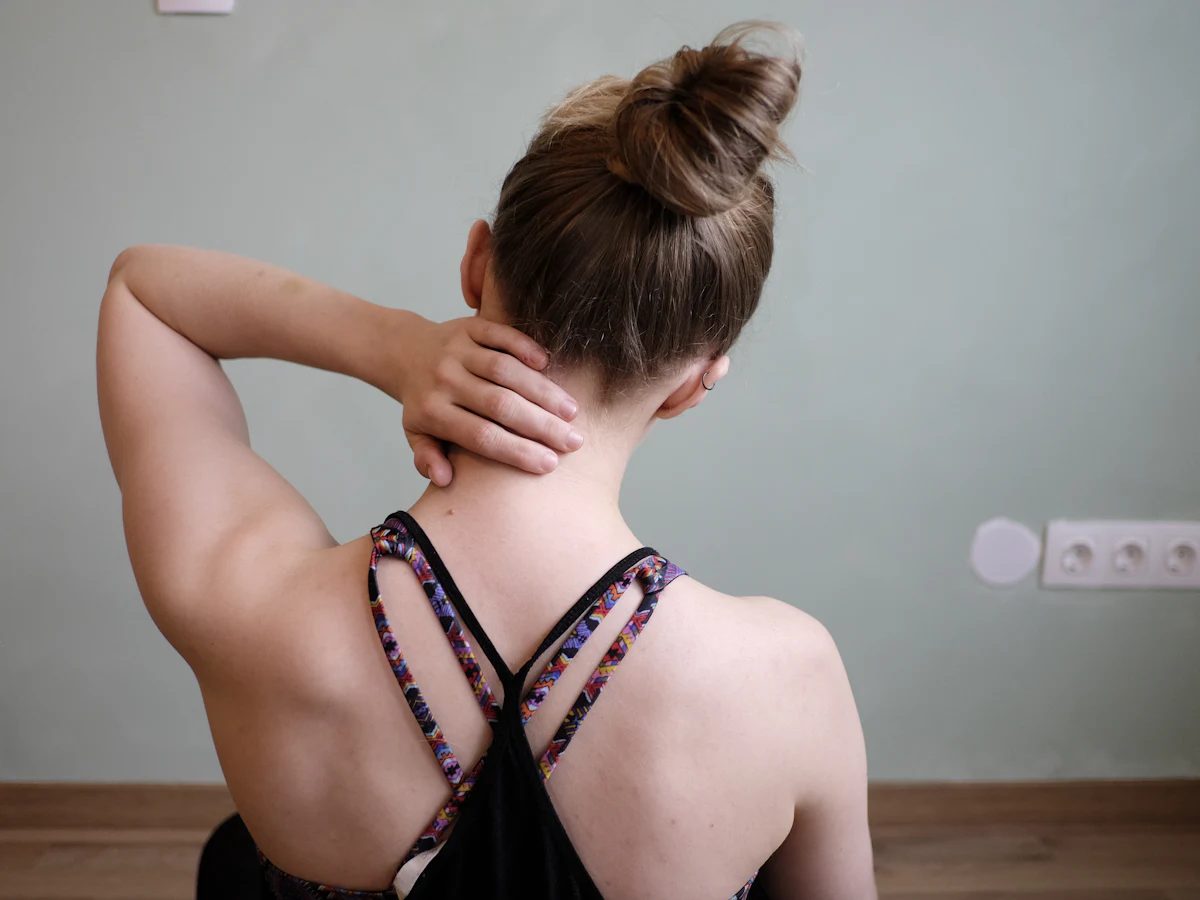
Fibromyalgia and widespread pain
Widespread pain, fatigue and sleep disruption, approached as a whole system rather than one sore spot at a time.
Read moreSomething else?
Nerve pain, endometriosis, TMJ, IBS, arthritis, phantom limb pain, cancer-related pain, medical procedures and dental anxiety are all common reasons people come to me. If your pain is not on this list, ask.
Ask in your request (opens the secure SimplePractice appointment request form in a new tab)
Hypnosis does not mask pain. It changes how your brain builds it
Pain is not a signal your body sends and your brain receives. It is a conclusion your brain reaches — from tissue signals, plus context, memory, fear, attention and expectation. Hypnosis works on the second half of that list.
It turns down the volume
Brain imaging during hypnotic analgesia shows measurable change in the regions that govern how unpleasant a sensation feels — not just how you report it. The intensity dial and the "how much this bothers me" dial are separate, and hypnosis reaches both.
It breaks the guarding cycle
Pain makes you brace. Bracing makes more pain. Months of that and your muscles hold a pattern nobody asked for. In trance, that protective tension can be released far more easily than by willpower — and the release is what you rehearse afterwards.
It rebuilds expectation
When your nervous system has predicted pain for years, it keeps predicting it — and prediction alone can generate the experience. Hypnosis is unusually good at editing expectation, because that is essentially what suggestion is.

You leave with a recording made for your pain, not a stock track
The single biggest predictor of whether hypnosis helps pain is how much you practise between sessions. So I do not hand you a generic download.
After we have worked together and I know how your pain behaves — where it sits, what sets it off, what language your body responds to, what you want to be able to do again — I record a hypnosis session built around that. Your triggers. Your imagery. Your goals. In my voice, which by then your nervous system already associates with settling.
- Recorded after your session, personalised to your presentation
- Yours to keep, on your phone, for the 3am flare-ups
- Updated as your pain changes and the work moves on
- Ten to twenty minutes — short enough that you will actually use it
What the research actually says
I would rather you came in with accurate expectations than oversold ones. Here is the honest state of the science.
Where hypnosis does well
- Acute and procedural pain — the strongest and most consistent finding, with a medium effect against standard care
- Musculoskeletal and neuropathic chronic pain — moderate effects on pain intensity and interference when treatment runs long enough
- Headache and migraine — a well-studied non-drug option
- Pain interference — sleep, mood and what you can actually do often shift before the pain number does
Where I will not overclaim
- Results vary widely between individuals, and a minority of people get little from it
- Short courses of two or three sessions tend to underperform in trials
- Meta-analyses of chronic pain as one undifferentiated category show smaller and less consistent effects than condition-specific work
- Average pain reduction across studies is meaningful but partial — roughly a point on a ten-point scale, not the elimination of pain
- It is complementary care. It does not replace diagnosis or treatment
My working position
Hypnosis is a genuinely useful, side-effect-free tool that helps many people meaningfully and helps some people enormously — and it is not magic. If after a fair trial it is not moving anything for you, I will say so and help you think about what might.
From first click to lasting change
Request an appointment
One short form. Tell me what you are dealing with and what you are hoping for. No payment is taken here, and there is nothing to schedule yet — you are simply telling me you want to start.
I reply within one to two business days
With your intake paperwork and a secure booking link. If I do not think I am the right person for your case, I will say so then and point you somewhere better.
Book, pay and complete your paperwork
The Calendly link takes payment and your session time in one step. Your intake forms live in a private, HIPAA-compliant client portal and you fill them in whenever suits you.
First session, 60 minutes
We map your pain properly: history, triggers, what has been tried, what you want back. Then we do hypnosis. You experience the shift in the room, on day one.
Your personalised recording arrives
Built from your session, for your nervous system. This is where the change gets consolidated between appointments.
Build momentum, then maintain
Six to eight sessions is the usual arc. After that, most people move to occasional maintenance — monthly, then quarterly, then as needed.
Request an appointment (opens the secure SimplePractice appointment request form in a new tab)

Eugene Berezin, MA, Registered Hypnotherapist
I am a Registered Hypnotherapist in Washington State (#HYPN.HP.70073119) with a Master's degree in psychology and more than ten years working in mental health as a therapist, counsellor and social work professional.
My training runs through clinical hypnotherapy, motivational interviewing, Internal Family Systems, CBT and ACT. In practice that means I do not just deliver suggestions at you — I work with the part of you that has been braced against this pain for years, because that part usually has a reason.
I built my practice as an openly gay clinician, and LGBTQ+ clients make up much of my work. If you have ever had to manage a doctor's discomfort while trying to describe your own, you will not have to do that here. Everyone is welcome; nobody has to explain themselves.
What clients have said
"I had a stiffness in my neck for many years. Hypnosis was such a healing experience."
"After my fall, my recovery sped up in a way my physio did not expect."
"I hurt my back at the gym and I was back to normal much faster than the last time this happened."
Shared with permission and initialled for privacy. Individual results vary; these are not a promise of outcome.

Washington & the Seattle area
I am registered with the Washington State Department of Health and work with clients in Seattle, Bellevue, Tacoma, Everett, Olympia, Spokane and across the state.

Online, anywhere in the world
Hypnotherapy translates to video better than almost any other modality — you have your eyes closed for most of it. I work across time zones, in English and Russian.
Before you book
Does hypnosis actually work for pain?
For some kinds of pain, yes — and the research is reasonably good. Systematic reviews find hypnosis produces a moderate reduction in pain intensity and pain interference for musculoskeletal and neuropathic chronic pain, with the clearest benefit when treatment runs eight sessions or more. The evidence is stronger still for acute and procedural pain. It is not a cure, and it does not work for everyone. It is a skill you build, and it works alongside your medical care rather than instead of it.
Will I be unconscious or lose control?
No. Clinical hypnosis is a focused, absorbed state — much closer to being lost in a film or a long drive than to sleep. You hear everything, you remember it, and you can stop at any point. You cannot be made to do anything you do not want to do.
How does payment work, and do you take insurance?
I am a private-pay practice and do not bill insurance directly. Sessions are $250 for 60 minutes. Once you send an appointment request I reply with your intake paperwork and a secure Calendly link, where you pay and book your session time together. Nothing is charged on the request form itself. Many clients pay with an HSA or FSA card, and I can provide a superbill you may be able to submit to your insurer for out-of-network reimbursement, though coverage for hypnotherapy is not guaranteed.
How many sessions will I need?
Plan on six to eight to start. The pain research consistently shows that short courses underperform and that benefit accumulates with practice, which is why I build a personalised recording for you to use between sessions. Some people notice a shift after one or two; the durable changes tend to come later.
Do I have to be in Washington State?
No. I am a Registered Hypnotherapist in Washington and I see clients across the state, but hypnotherapy sessions run online by secure video and I work with clients internationally. All you need is a private room, headphones and a stable connection.
Is this a replacement for my doctor or my pain medication?
Absolutely not. Hypnotherapy is complementary care. Please keep your medical team, keep any new or changing pain properly investigated, and never adjust prescribed medication without talking to your prescriber. Hypnosis works best as one part of a broader plan.
Ready to try a different approach to your pain?
Send a request and tell me what you are dealing with. I reply within one to two business days with your intake paperwork and a secure link to pay and pick your time. No payment is taken at the request stage.
Requests go to a secure, HIPAA-compliant SimplePractice form — no payment is taken there. Sessions are held online by video, worldwide.